
Solar Generator
Estimate solar generator battery capacity, inverter wattage, daily watt-hours, backup days, and panel count for portable power setups.
Solve electrical and technical calculations with privacy-first, browser-based tools.
Engineering calculations demand precision and the correct formula — a misremembered Ohm's law rearrangement or a wrong unit prefix can damage hardware or fail a design review. Our free engineering calculators online give you accurate results in the browser, with no account and no data leaving your device. The collection covers electrical calculations (Ohm's law, resistor values and colour codes, voltage dividers, power dissipation), unit conversions specific to engineering work, and technical maths used by makers, students, and professional engineers. Each calculator uses the established physical formula and standard constants, and shows the relationship being computed so you can sanity-check the result against your own intuition. Whether you're sizing a current-limiting resistor for an LED, decoding a resistor's colour bands, or converting between power units, the tool removes arithmetic error from the equation so you can trust the number.
Estimate solar generator battery capacity, inverter wattage, daily watt-hours, backup days, and panel count for portable power setups.
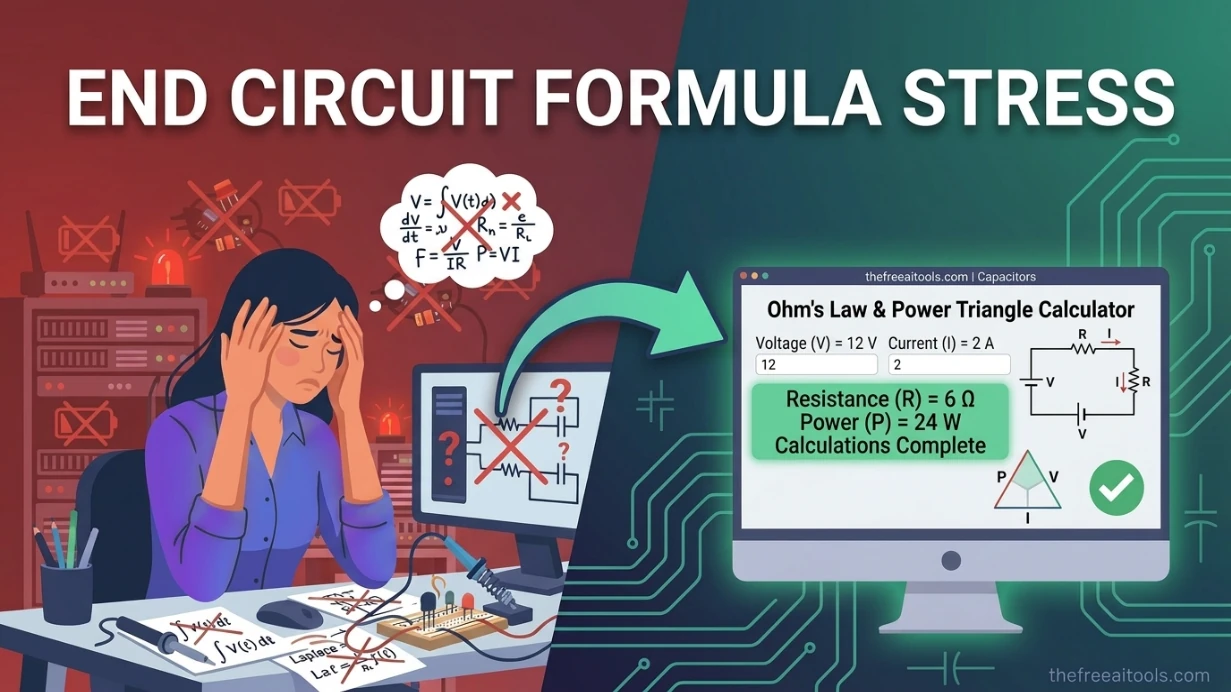
Calculate voltage, current, resistance, power, and related electrical values with unit switching and visual formulas. It is ideal for students, technicians, and makers who need quick checks with clear explanations.

Decode resistor bands visually, calculate tolerance, and switch between 4-band, 5-band, and 6-band modes. It helps electronics learners and hobbyists avoid common reading mistakes.
Calculate the current-limiting resistor for an LED (using the supply voltage, the LED's forward voltage, and desired current), decode resistor colour bands, and work out voltage-divider outputs. These are the calculations that come up constantly in Arduino and Raspberry Pi projects.
Apply Ohm's law in any direction (V=IR and its rearrangements), calculate power dissipation (P=VI=I²R), and check series and parallel resistor combinations. The calculators show the formula used so they reinforce learning rather than just giving an answer.
Verify component values during design, convert between power units (watts, horsepower, kW), and run quick sanity checks before committing to a design. Catching an order-of-magnitude error here is far cheaper than discovering it in a prototype.
Decode resistor colour codes when the markings are all you have, calculate replacement component values, and convert units on the fly. Useful when you're at the bench without a reference chart to hand.
Use R = (V_supply − V_forward) / I_LED. For a typical red LED (2V forward voltage, 20mA) on a 5V supply: R = (5 − 2) / 0.02 = 150 ohms. Round up to the nearest standard value (often 220 ohms) to stay safely within the LED's current limit. The calculator does this for you.
Ohm's law is V = I × R, which rearranges to I = V / R and R = V / I. Combined with power (P = V × I), you can derive P = I² × R and P = V² / R. The calculators let you solve for whichever variable you're missing.
Standard 4-band resistors use the first two bands as significant digits, the third as a multiplier, and the fourth as tolerance. For example, brown-black-red-gold is 1, 0, ×100, ±5% = 1,000 ohms (1k) ±5%. The colour-code calculator decodes 4-, 5-, and 6-band resistors.
The calculators use exact formulas and full floating-point precision, so the maths is reliable. For real designs, remember to account for component tolerances (resistors are commonly ±5% or ±1%), temperature effects, and power ratings — the calculator gives the ideal value, and you add the engineering margin.
Yes. 1 mechanical horsepower equals about 745.7 watts, and 1 metric horsepower equals about 735.5 watts. The power converter handles watts, kilowatts, and both horsepower definitions, which matters because motor specs use different conventions in different regions.
No. All engineering calculations run locally in your browser using client-side JavaScript. Nothing you enter is transmitted or stored, so the tools work offline once the page has loaded.
Hand-picked sets of free tools and guides related to engineering & technical.
224+ browser-based tools across 13 categories — all free, no sign-up required.